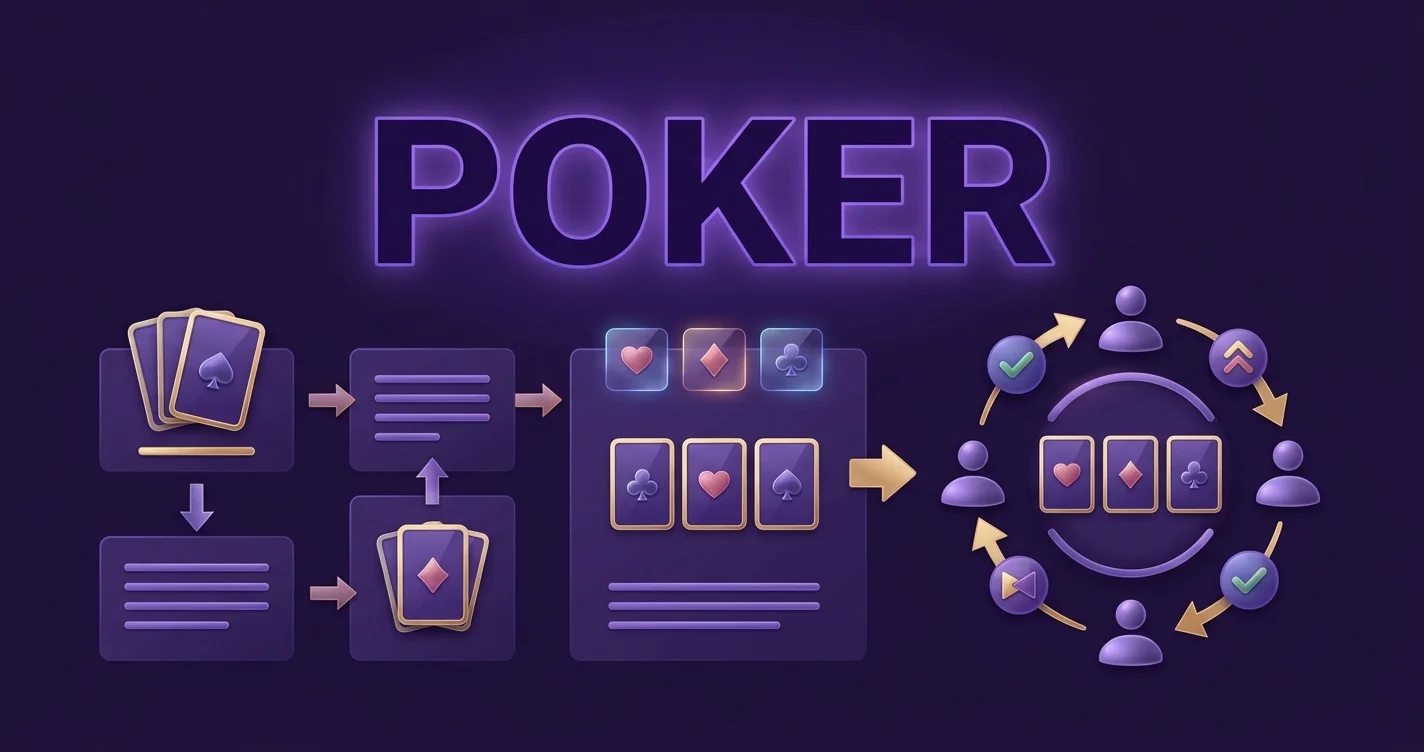
Poker is a group of card games in which players place bets based on the strength of their cards and on what they think their opponents hold. The winner is the player with the strongest hand at showdown, or the one who made everyone else fold. Unlike slots or roulette, in classic poker you are not playing against the casino but against other people.
That is why poker is often described as a game where a player's decisions affect the result more than in most other gambling games. But randomness never disappears: the cards are dealt at random, and even the best player can lose in streaks.
How the game works: Texas Hold'em as an example
The most popular variant is Texas Hold'em. Its rules are easy to follow when broken down into steps.
- Blinds. Two players at the table post small forced bets before seeing their cards (the small and big blinds). This creates the first pot, which gives players something to fight for.
- Preflop. Each player receives two face-down cards. The first betting round begins.
- Flop. Three community cards are dealt face up on the table. Second betting round.
- Turn. A fourth community card is revealed. Third betting round.
- River. The fifth and final community card. Final betting round.
- Showdown. If several players remain, they reveal their cards. The best five cards out of seven (two of your own and five community cards) decide the winner.
Player actions
- Fold - discard your cards and leave the hand.
- Check - pass the action without betting, if no one before you has bet.
- Call - match the current bet.
- Bet or raise - place a bet or increase the existing one.
- All-in - bet all the chips you have in front of you.
Hand rankings from strongest to weakest
| Hand | Description |
|---|---|
| Royal flush | 10, jack, queen, king, ace of the same suit |
| Straight flush | Five consecutive cards of the same suit |
| Four of a kind | Four cards of the same rank |
| Full house | Three of a kind plus a pair |
| Flush | Five cards of the same suit |
| Straight | Five consecutive cards of different suits |
| Three of a kind (set) | Three cards of the same rank |
| Two pair | Two different pairs |
| Pair | Two cards of the same rank |
| High card | No combination; the highest card counts |
If hands are of the same type, the one with higher cards wins, and then additional cards, known as kickers, are taken into account.
Main poker variants
- Texas Hold'em. Two hole cards and five community cards. The most widespread format.
- Omaha. Similar to Hold'em, but each player receives four hole cards, and exactly two of them must be used in the final hand. Pots are usually bigger and situations more complex.
- Stud. There are no community cards, and some of each player's cards are visible to everyone.
- Casino poker against the dealer. This is a separate group of games (for example, three-card variants or Hold'em against the dealer). Here you compete with the casino, not with people, so the usual house edge built into the payout rules applies.
It is important not to confuse these two worlds. In poker against other players, the casino or poker room earns from commission, while in casino poker against the dealer it earns from the mathematical edge in the rules.
Where a poker room's income comes from: rake
When you play against people, the operator does not bet against you. It takes a rake: a small percentage of each pot or a fee for entering a tournament.
Here is an example with simple numbers. The pot in a hand reaches 200 units, and the rake is 5%. The operator takes 10, and the winner receives 190. If you play many hands, these deductions add up, and they weigh on your results regardless of whether you win or lose individual hands. That is why even a strong player has to play well enough to overcome the rake.
In tournaments the rake takes the form of a fee. The notation "90+10" means that 90 goes to the prize pool and 10 is the operator's fee. In other words, the fee is roughly 11% of the amount that goes to prizes.
Cash game or tournament
| Cash game | Tournament | |
|---|---|---|
| Chips | Have real cash value; you can leave the table at any time | Issued at the start and are not money in themselves |
| Risk | You risk only the money you put on the table | Maximum loss is the buy-in |
| Winnings | Proportional to your chips | Only the top places are paid |
| Variance | Lower | High: you can go a long time without cashing |
You can read about the general logic of competitions with a prize pool in the article on tournaments. In poker tournaments, the blinds also rise over time, so your chips cover fewer and fewer hands and the game speeds up.
Calculation example: is a call worth it
Poker is often reduced to bluffing, but a significant part of the decisions is simple arithmetic. Let's look at a situation involving pot odds.
The pot is 100. Your opponent bets 50. Now the pot is 150, and to stay in the hand you need to add 50. You risk 50 to potentially win 150. Your share of the final pot after calling: 50 / (150 + 50) = 25%. So your hand needs to win at least 25% of the time for the call not to lose money in the long run.
Now imagine you have four cards to a flush after the flop: you have 9 cards that complete the hand (so-called outs). There are 47 unknown cards left (52 minus your two and the three on the table).
- Chance of hitting the flush on the next card: 9 / 47, about 19%.
- Chance of hitting it over two cards (turn and river): 1 - (38/47 × 37/46), about 35%.
Let's compare. If you see only one card, 19% is less than the required 25%, and by arithmetic alone the call loses money. If you are guaranteed to see both cards with no new bets, 35% is already more than 25%. But in practice your opponent may bet again, and a flush does not always win. Experienced players also account for implied odds: how much more can be won in later rounds if the hand comes in. This is a simplified example, not instructions that guarantee profit.
What decides the outcome in poker: skill or chance
Cards are dealt to you at random. Over the short run even a weaker player can beat a stronger one simply because the cards fall their way. This is both attractive and dangerous: the winner of a few sessions easily credits success to themselves, and the loser blames bad luck, and both assessments can be wrong.
Over the long run, strong decisions add up: choosing the right starting hands, the ability to calculate odds, betting discipline, an understanding of table position. But no one can guarantee that learning will bring in money. If you want to understand how much results can fluctuate even with correct play, see the article on volatility. In this sense poker has its own roller coaster too.
Common beginner mistakes
- Playing too many hands. Beginners want to take part in every one, but most starting hands are weak and should be folded.
- Bluffing constantly. A bluff works when the betting story looks believable and the opponent is capable of folding. Against players who almost never fold, bluffing just burns money.
- Not counting odds. Calling "because maybe I'll hit" without calculation is the most common way to waste chips.
- Ignoring position. The player who acts later sees opponents' actions first. This is a significant advantage, and play from late position can be wider than from early position.
- Tilt. After a bad hand, a player starts playing emotionally, raising stakes and trying to win it back. This is the path to losing money fast.
- Playing beyond your budget. If the stakes are too big for your funds, one bad streak knocks you out of the game.
Poker myths
"A strong hand always wins"
No. Even the best starting hand can lose if the wrong cards come on the table. And a weaker hand can win many times if the opponent folds. Poker is judged over the long run, not in a single hand.
"Online poker is rigged because I'm unlucky"
Losing streaks look suspicious, but they are natural for a game with random dealing. At fair poker rooms, card dealing relies on a random number generator. This does not guarantee that you won't lose, and it does not prove that you are being cheated. It only means the cards don't "know" about your results.
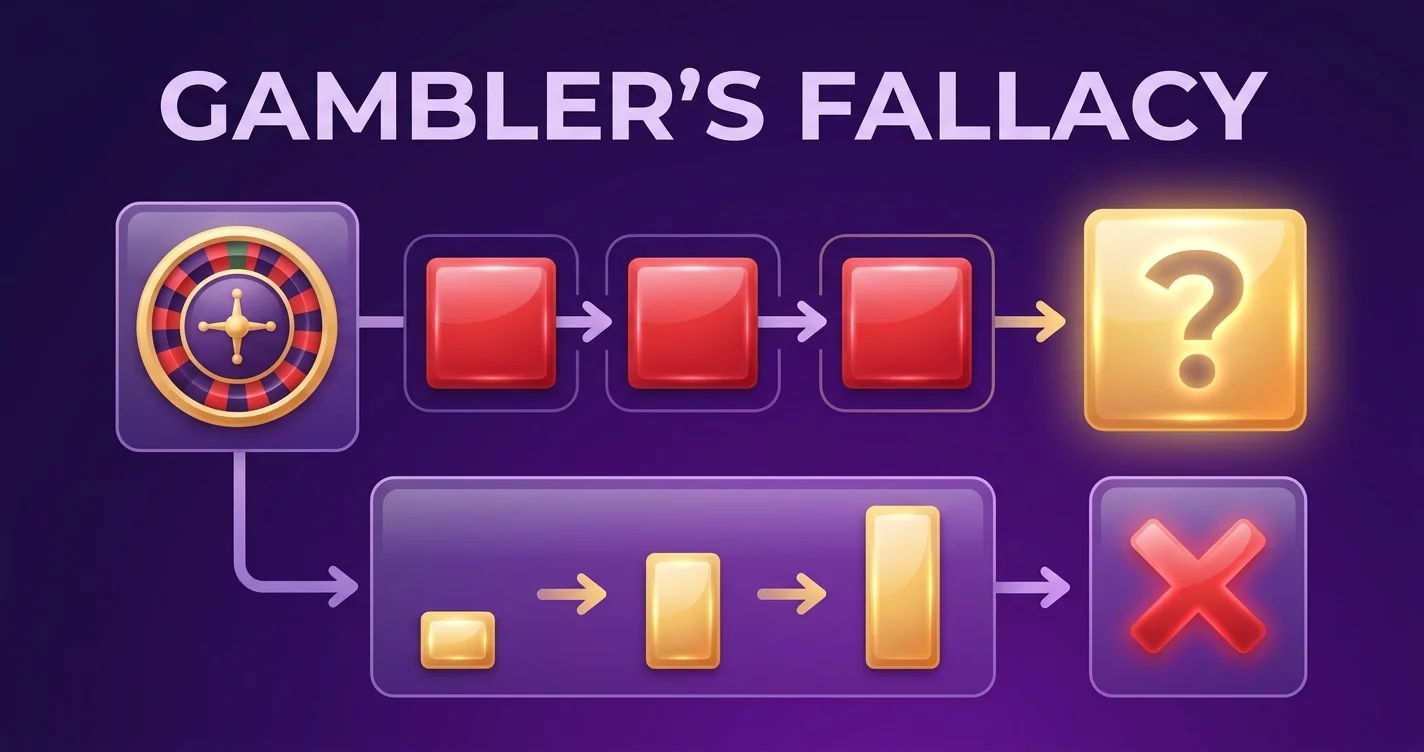
"After a losing streak, luck is bound to turn"
No. Past hands do not affect future ones. The phrase "it's my turn now" is a classic fallacy.
"Poker is only about bluffing"
Bluffing is important, but its usefulness is limited. A significant part of strong players' profit comes from smart decisions based on odds and observations.
How poker affects a player's choices
Before sitting down at a table, it's worth answering a few questions.
- Who am I playing against: people or the dealer? This determines whether your skill matters and who earns from your play (rake or the edge in the rules).
- Which format suits me? A cash game gives more control over risk; a tournament offers a chance at a big prize for a limited buy-in, but with long periods without winning.
- How much can I afford to lose? This is what the concept of a bankroll is for. A common guideline is to have funds for many buy-ins, not just one or two. This is not a rule but a way to survive normal swings.
- Do I understand the rules of the chosen variant? Omaha and Hold'em look similar, but decisions in them are different. Don't play for real money until you have learned the hand rankings, the order of betting and the rules for splitting the pot.
Before playing on any site, including RichTop, read the rules of the specific game and the terms under which bonuses or rakeback are credited, as they may differ from game to game.
Responsible gambling
Poker demands attention and a cool head, while fatigue and emotions quickly worsen decisions. A few simple habits help you stay in control:
- Decide in advance how much you are prepared to lose, and don't top it up mid-session under the influence of emotions.
- Take breaks, especially after a big loss or a big win.
- Don't treat the game as a way to earn money or recover lost funds.
- Stop playing if you feel irritated or want to "win it all back right now."
You must be at least 18 to play. If you feel the game is no longer entertainment, use self-limitation tools. At Rich Top there is self-exclusion for a period from 6 months to 5 years, as well as tips on controlling your play.
In brief
- Poker is a game in which you usually compete against other players, not against the casino.
- The result depends on the cards and on decisions, but over the short run chance often prevails.
- Rake and tournament fees are a constant cost that must be taken into account.
- Pot odds help you make decisions but do not guarantee winnings.
- Budget, discipline and the ability to stop matter more than any strategy.




 Google

 Payment History